
Help Support Digitization of The Nickel Library
This project will digitize 175 issues of The Nickel Library, totaling approximately 5,600 pages. Every $25 donation will digitize one issue. These funds will be used to support the hiring of undergraduate student employees, who perform the majority of our digitization work.
Launched in Chicago in 1877, The Nickel Library was the first five cent dime novel series published in the United States. Following its success, nickel weeklies went on to dominate newsstands across the country from the 1880s into the 1910s, shifting the audience for dime novels away from adults and toward juveniles. Because they were so affordable, this was one of the first formats of popular fiction that children could purchase for themselves, unmediated by the preferences of parents and guardians--providing they didn't get caught!
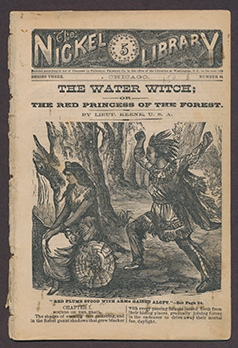
Like many early dime novels, the series consists mostly of frontier and Western stories about the violent conflicts between Native Americans and white settlers. As its juvenile audience grew, however, young adult protagonists became more common, as did adventure, exploration, detective, and sea stories. Covers featured dynamic and often expressionistic engravings.
Contributors make up a who's who of Midwestern professional authors from the late nineteenth century. Sixty-three of the novels in the series were written by St. George Rathborne, who also edited The Nickel Library before he went on to become an author of juvenile series books, including the Pioneer Boys series as "Harrison Adams" and the Boy Scouts series as "Herbert Carter." Other major contributors included Thomas C. Harbaugh, William H. Manning, James Milford Merrill, George Waldo Browne, and Weldon J. Cobb, Jr. Some of Luis Senarens' first published work also appeared in the series. (The Cuban-American author later created the hugely-popular Frank Reade, Jr., one of the first American science fiction heroes.)
The Nickel Library's importance to dime novel history and children's literature was mostly forgotten until its rediscovery by the bibliographer (and Chicago resident) Albert Johannsen. The earliest issues are almost impossible to find because they had such small print runs, with Johannsen speculating that many may no longer exist. NIU acquired Johannsen's own collection in 1967, and now holds more issues of this scarce series than any other library.
The Horatio Alger Society has generously agreed to match up to the first $1,000 in funding, doubling the impact of your gift.
No updates have been added yet.
Donors
View All Donors
Advocates
Taylor Mark Prahar-Ryals
Generated 1 clickKathleen Chamberlain Ph.D.
Generated 2 clicksDemian Katz
Generated 2 clicksCommunity Advocates
Generated 6 clicksBecome an Advocate and be recognized for your impact!
Share with your Network
Share the campaign to track the number of clicks, gifts and dollars you generate (Note: If you share without signing up or logging in, your impact will be counted as Community Advocate)
Inspire your Friends & Peers
Encourage others to give with a Matching Gift or Challenge.
Tell your Story
Create a Personal Video encouraging others to join you in supporting the campaign.